2026 Municipal Election - Context
Context for the 2026 Ontario Municipal Election
There are 444 municipal governments in Ontario, yet only 414 municipal governments hold elections. Why? Because some upper tier municipal governments are populated by a lower tier election process (e.g., counties and some regions and one district) as well as those municipalities that have the entire council acclaimed.
Those 414 municipal governments include:
- All lower-tier municipalities, and
- All single-tier municipalities
- 2026 Ontario Municipal Election website
Information is based on the 2021 Canada Census data.
Approximately 6,663 candidates compete for the 2,800 elected positions up for grabs. Approximately 435 of the 2,800 elected officials also sit on the upper tier, for a total of 3,235 seats. In 2026, 624 incumbents did not run compared to 692 incumbents in 2022 and 607 in 2018. In 2022, the total number of seats was 3,267. The total number of positions was 2,842 with 452 that also sit on the upper tier. The difference between the number of seats from 2022 to 2026 reflects the changes in Simcoe County, Niagara Region, and several other lower tier municipal council sizes.
ACCLAMATIONS
| 2026 | 2022 | 2018 | |
| Total candidates acclaimed (includes HOC) | 400 (123 female) | 548 (163 female) | 477 (147 female) |
| Total heads of council (HOC) acclaimed | 104 (30 female) | 139 (37 female) | 120 (27 female) |
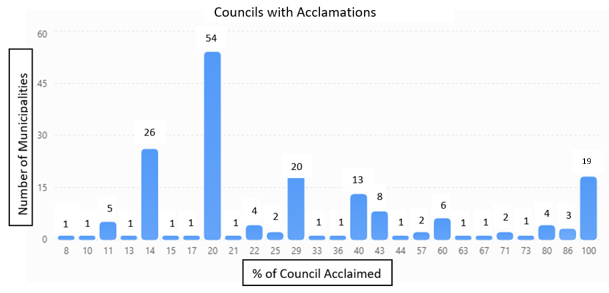
| Total number of councils fully acclaimed | 19 | 32 | 26 |
Acclaimed Candidates
- There has been a decrease in 2026 in the total number of candidates acclaimed. In 2026 there were 400 acclamations; in 2022: 548; and in 2018 there were 477 acclamations.
- In 2026, 104 have been acclaimed as Head of Council (Mayor/Reeve), 29% of which are female. In comparison to the 2022 acclaimed, 139 were acclaimed as Head of Council (Mayor/Reeve), 27% were female, there were 120 acclaimed as Head of Council in 2018, 23% were female.
- In 2026, the number of female candidates acclaimed increased by 7% as compared to 2022. In 2022, the number of female candidates acclaimed increased by approximately 11% as compared to 2018.
- The data indicates that there is a decrease in female and male acclaimed candidates for both councilors and Head of Council in 2026.
Entire Councils Acclaimed:
- In 2026, 19 municipalities or 5% of municipalities holding elections (414) in Ontario were fully acclaimed, i.e. entire council was acclaimed. This has decreased from 2022 at 8% and 2018 at 5%.
- In 2026, the population of the acclaimed municipalities ranges from 105 to 8,057.
- In terms of population, the smallest in this year’s election is the Township of Brethour with a population of 105 and the largest is Town of Kapuskasing at 8,057.
CANDIDATES
| 2026 | 2022 | 2018 | |
| Total number of candidates | 6,663 | 6,306 | 6,658 |
| Total candidates female | 2,103 | 1,931 | 1,808 |
| % Total female candidates | 32% | 31% | 27% |
Low Candidature:
This situation is where one or more candidates are acclaimed or the number of candidates running for positions does not exceed two candidates.
Low candidature occurs in 213 municipal governments (54%) of the 395 municipal governments where voting will occur. (Acclaimed council positions are not included in this figure).
In other words, in the remaining 183 municipal governments, there are more than 2 candidates per seat to be elected, if the seat is up for election.
Gender:
- Across Ontario, there are more female candidates in 2026 than in 2022. This year, 32% or 2,103 of all candidates are female. This has increased compared to 2022, where 1,931 or 31% of all candidates were female.
- In 2026, the 28 municipal governments with population greater than 100,000, had a ratio of female to male candidates of 30% to 70%; which is marginally lower than province-wide of 32% to 68%.
Incumbents:
- In 2026, 2,161 incumbents are running for a same or new position which is 32% of the total candidates running (6,663). 2,161 incumbent candidates are 77% of all possible candidates running out of the 2,800 seats available.
- In 2026, 4,502 candidates who are new for this election which is 68% of the total candidates running (6,663).
- In 2022, 2,141 incumbents ran for a same or new position which is 34% of the total candidates who ran (6,325). 2,141 incumbent candidates are 75% of all possible candidates running out of the 2,842 seats available.
- In 2022, 4,184 candidates who are new for this election which is 66% of the total candidates who ran (6,325).
VOTE METHOD
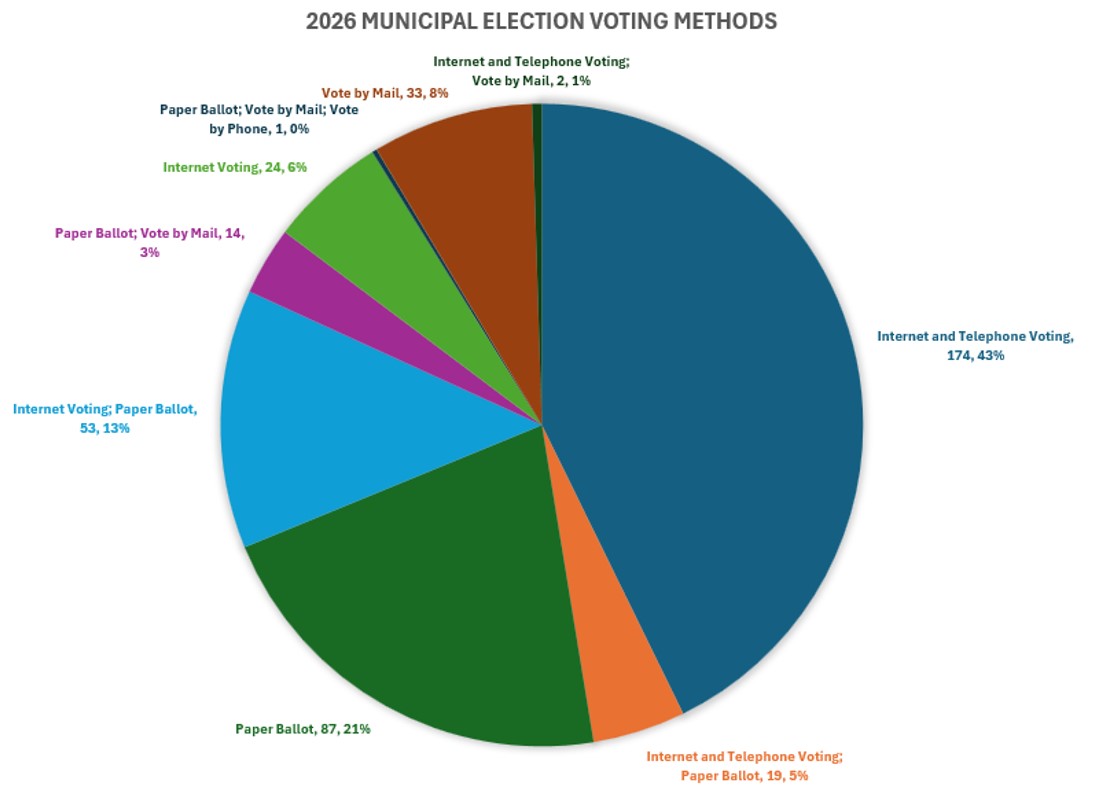
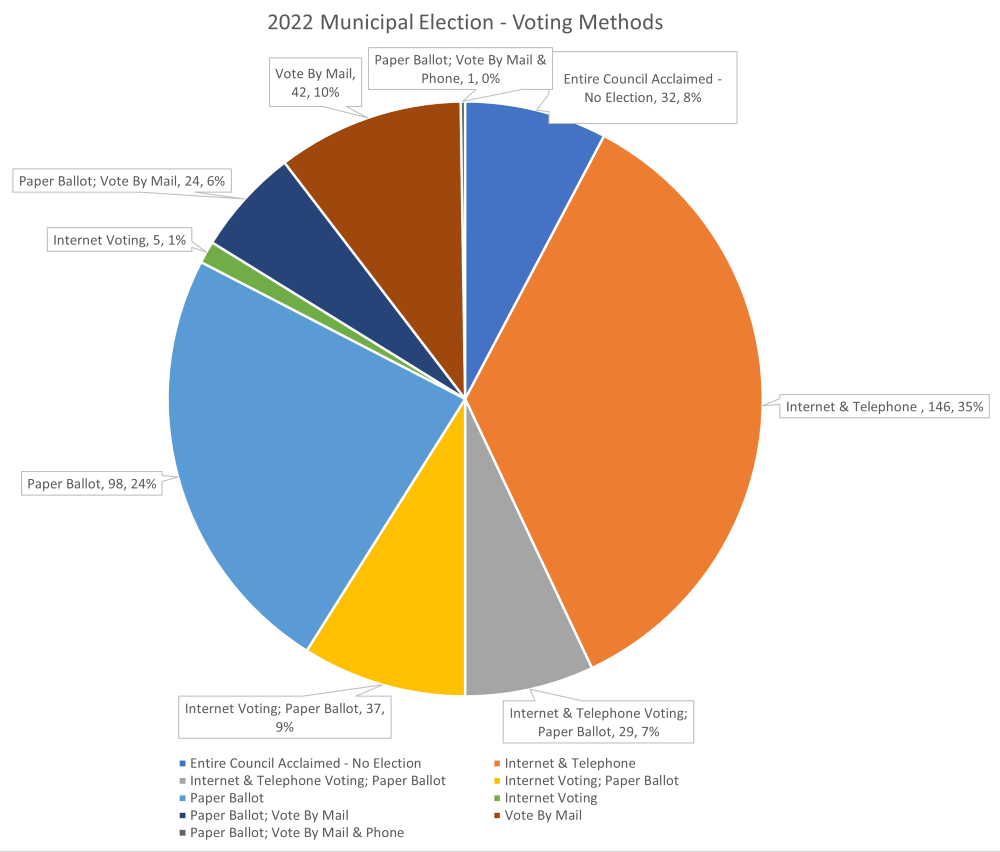
Municipal government voting methods in 2026 has continued to move to technology- based methods.
- In 2026, 272 municipalities or 66% used internet voting in a combination with other vote methods. In comparison to 2022, 217 municipalities or 52% used internet voting in a combination with other vote methods.
- In 2026, 174 municipalities or 43% of municipal governments will use internet and phone voting in combined methods, which is 28 more municipalities than the 2022 election.
- The traditional paper only ballot is still used in about 87 municipalities or 21%. In 2022, 98 municipalities or 24% were using paper only ballots.
- In 2026, we have 50 mail-in ballots as compared to the 2022 election at 71 municipalities. This shows a 30% decrease from the previous election.
- 2026 and 2022 charts illustrate the methods used.

BALLOT QUESTIONS
There are 4 municipalities with ballot questions in 2026. There were 2 municipal governments with ballot questions in 2022, compared to 4 in 2018:
County of Prince Edward
Are you in favour of a third-party review of Council size and related ward boundaries?
City of Timmins
Do you support changing the Ward System for electing members of Council?
Town of Wasaga Beach
Are you in favour of moving to a ward system?
Township of Killaloe Hagarty & Richards
Are you in favour of abolishing the current ward system in the Township of Killaloe, Hagarty and Richards?
Are you in favour of reducing the size of Council to four (4) Councillors and one (1) Mayor for the Township of Killaloe, Hagarty and Richards?
Disclaimer The Association of Municipalities of Ontario (AMO) has created this election statistics page as a public service. AMO cannot guarantee and assumes no legal liability or responsibility for the accuracy, currency and completeness of the information posted.